

There are destinations that surprise you.
And then there are destinations that completely reshape your understanding of a country.
Our recent journey through the Peloponnese during AdventureWEEK 2026 did exactly that.
Over the course of nine unforgettable days, we travelled from the coastal landscapes of Loutraki to the mountain villages of Arcadia, from ancient archaeological wonders to hidden coves, sea caves, rivers, wellness retreats, and traditional stone towns where time seems to move differently.
Hosted in collaboration with the Adventure Travel Trade Association (ATTA), the Region of Peloponnese, local municipalities, and an incredible network of local partners, the experience brought together travel professionals from around the world to discover a side of Greece that many travellers never see.
This was not the Greece of crowded islands and cruise ports.
This was a Greece of authentic encounters, nature, adventure, gastronomy, tradition, and meaningful local experiences.
Arrival in Greece: Athens to Loutraki
The journey began at Athens International Airport, where the group slowly came together after long flights from different parts of the world. From there, we headed west toward Loutraki, leaving the urban rhythm of Athens behind and entering the gateway to the Peloponnese.

Before reaching our hotel, we stopped at the Old Isthmus Bridge by the Corinth Canal, one of the most symbolic entry points into southern Greece. Standing there, looking down at the narrow cut that separates mainland Greece from the Peloponnese, gave the trip a natural sense of arrival. It was not just a transfer stop, but the moment where the route truly began.

Already, the tone of the journey was clear. This was not going to be a simple sightseeing trip through Greece. It was going to be a route that moved between coast and mountains, history and adventure, hosted experiences and spontaneous conversations, with the Peloponnese slowly revealing itself one layer at a time.
Sea Kayaking Through the Blue Lagoon & Heraion
One of the first major highlights came the following day at the spectacular Blue Lagoon near Lake Vouliagmeni, a peaceful body of water framed by rocky hills, pine-covered slopes, and the deep blue tones of the Corinthian Gulf.

This was the perfect first adventure of the trip. Rather than beginning with a long hike or a demanding activity, sea kayaking gave the group a gentle but active way to connect with the landscape. From the water, the coastline felt completely different: quiet, open, and almost untouched.
We paddled through the narrow channel that links the lagoon with the Corinthian Gulf, surrounded by clear water and dramatic coastal scenery. The route gradually led us toward the archaeological area of Heraion of Perachora, where ancient ruins sit close to the sea in a setting that feels both wild and sacred.
That combination became one of the strongest themes of the trip. In the Peloponnese, history is not confined to museums or fenced-off monuments. It appears naturally within the landscape, beside beaches, mountains, villages, rivers, and hiking trails.
The experience offered exactly what adventure travellers often look for in Greece but do not always find on the more crowded island routes: nature, movement, archaeology, and a strong sense of place, all in one accessible morning.
Into the Mountains of Arcadia
Leaving the coast behind, we drove into the mountainous heart of the Peloponnese, where the scenery changed completely within only a few hours. The open blue of the Corinthian coast gave way to dense forests, deep gorges, stone villages, and narrow mountain roads that revealed a quieter, more traditional side of Greece.
The route toward Dimitsana and Stemnitsa was one of the first moments where the Peloponnese began to feel much bigger and more diverse than expected. This is not a region defined by one landscape. It moves quickly from sea to mountains, from archaeological sites to rural villages, from active adventure to slow, atmospheric travel.
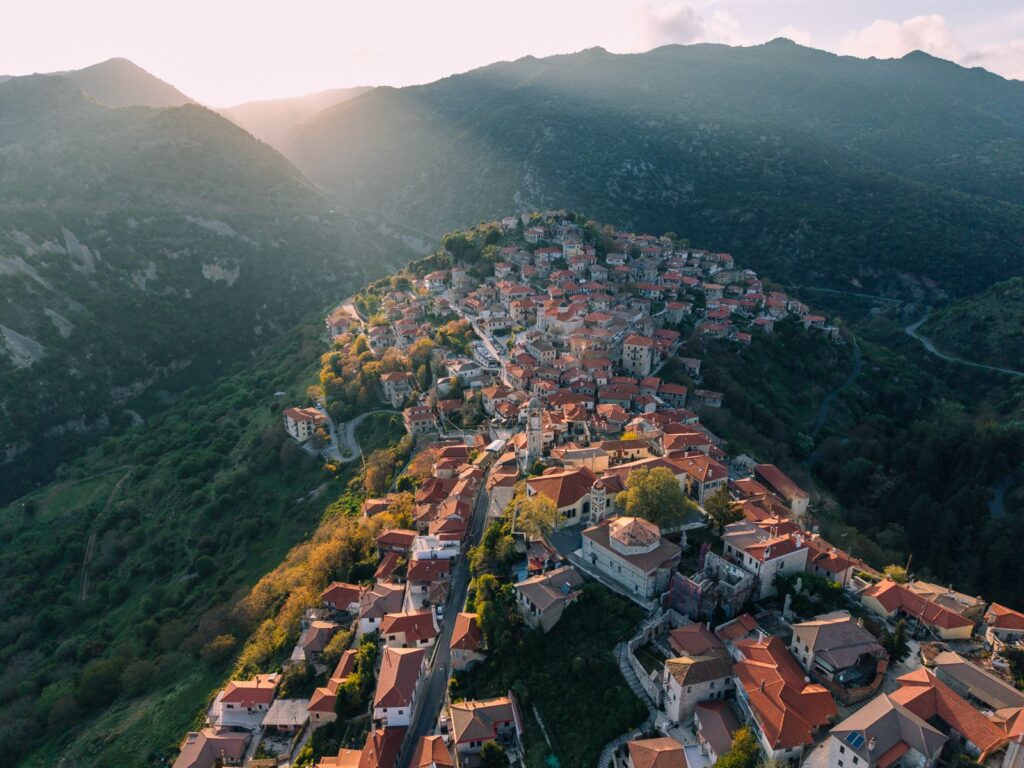
Dimitsana immediately stood out as one of the most beautiful villages of the trip. Built amphitheatrically on the slopes above the Lousios Gorge, it has the feeling of a place shaped by history rather than tourism. Stone houses, narrow lanes, mountain views, and a calm evening atmosphere made it feel both intimate and cinematic.
Stemnitsa offered a similar sense of character, with traditional architecture, quiet streets, and a strong connection to local craft, food, and mountain life. Together, these villages showed how much depth exists inland, away from Greece’s better-known coastal routes.
What made Arcadia especially memorable was the hospitality. From guesthouses and taverns to local cultural spaces and activity providers, every encounter felt personal. People were not simply presenting a destination; they were sharing their home, their traditions, and their pride in a region that deserves far more attention from international travellers.
Rafting with Trekking Hellas
AdventureWEEK would not be complete without real adventure, and Arcadia delivered it beautifully. One of the most memorable activity days took place with Trekking Hellas, whose team guided the group through the lush river landscapes of the region.

The experience was not only about rafting. It was about seeing the Peloponnese from a completely different perspective. After the quiet mountain villages of Dimitsana and Stemnitsa, the river brought a new kind of energy: fresh water, forested slopes, narrow passages, and that immediate feeling of being fully present in nature.
What made the activity especially valuable was how accessible it felt. It offered enough excitement to feel like a true adventure, but without becoming intimidating or overly technical. For travellers who want active experiences with professional guidance, this is exactly the kind of activity that makes the Peloponnese so appealing.
The day also reinforced one of the biggest strengths of the region: its diversity within short distances. In only a few days, the route moved from coastal kayaking to mountain villages, from river rafting to forest trails, from archaeological sites to boutique hotels and local taverns.
For adventure travellers, this variety is a major advantage. The Peloponnese is not a place where the experience depends on one famous site or one postcard view. It is a region where every day can feel different, while still remaining connected by landscape, culture, and genuine local hospitality.
Local Gastronomy & Rural Experiences
Throughout the journey, food became one of the strongest cultural connectors. In the Peloponnese, meals were not treated as simple stops between activities, but as part of the experience itself. Traditional taverns, mountain restaurants, local producers, and family-run establishments consistently became places for conversation, storytelling, and connection.

Experiences like Arkadiani showed how deeply gastronomy is tied to regional identity. The food was not presented as something decorative or staged for visitors. It came from local recipes, local ingredients, and a way of life that still feels closely connected to the land.
This is where the Peloponnese really shines for travellers who care about authenticity. Olive oil, herbs, cheeses, handmade pastries, vegetables, local wines, and slow-cooked dishes all helped tell the story of the region in a way that no monument or viewpoint could do alone.
The warmth around the table was just as important as the food itself. Meals gave the group time to slow down, speak with hosts, understand local traditions, and feel the generosity that defines so much of Greek hospitality.
For Bamba-style travel, these moments are essential. Adventure is not only about movement or outdoor activities. It is also about meeting people, tasting what they produce, understanding how they live, and leaving with a deeper emotional connection to the destination.
Abeliona Retreat & the Forests of Bassae
As we continued deeper into the Peloponnese, the rhythm of the trip shifted again. After the movement and energy of the rafting day, Abeliona offered something quieter: forest air, mountain silence, stone paths, and the feeling of being far from the usual tourist routes.

Abeliona Retreat was one of the most peaceful stays of the journey. Surrounded by trees and mountain scenery, it felt less like a hotel stop and more like a pause in the itinerary. It gave the group space to slow down, reconnect, and experience the inland Peloponnese at a more reflective pace.
Nearby, we visited the Temple of Apollo Epicurius at Bassae, one of Greece’s most fascinating UNESCO World Heritage Sites. Unlike more famous Greek monuments, Bassae feels remote and almost hidden, standing alone in the mountains with a powerful sense of mystery.

That isolation is part of what makes it so memorable. Reaching the temple does not feel like arriving at a crowded attraction. It feels like discovering a sacred place that still belongs to the landscape around it.
The surrounding forests and hiking routes added another layer to the experience. This part of the Peloponnese is ideal for travellers who want slower, more immersive journeys: walking trails, mountain lodges, archaeological depth, wellness elements, and quiet moments in nature.
For us, Abeliona and Bassae showed that adventure travel does not always need to be fast or intense. Sometimes the strongest experiences come from silence, distance, and the chance to feel a place without rushing through it.
Toward the Coast: Pylos & Navarino Bay
The route then shifted once again from mountains to coastline, showing how quickly the Peloponnese can change character. After the forests and stone villages of Arcadia, arriving in Pylos brought a softer Mediterranean rhythm: sea views, open squares, relaxed promenades, and the calm feeling of a coastal town shaped by history and water.

Pylos felt elegant without being overly polished. Its harbour, cafés, waterfront walks, and views toward Navarino Bay created a natural pause in the journey, allowing the group to recover from the more active mountain days while still remaining fully connected to the destination.
The Navarino Bay area revealed another side of the Peloponnese: refined coastal travel that still feels local and rooted. Rather than the crowded beach atmosphere many travellers associate with Greece, this part of the coast offered space, scenery, and a more understated kind of beauty.
Sea activities, beach walks, local restaurants, and scenic drives created a smooth transition between adventure-heavy days and slower moments of connection. It also showed how well the Peloponnese works for balanced itineraries, where active experiences can be paired with comfort, good food, coastal relaxation, and cultural depth.
For travellers who want Greece beyond the obvious island routes, Pylos and Navarino Bay are a strong reminder that the mainland coastline can be just as beautiful, often with more authenticity and far fewer crowds.
Kalamata: More Than Olive Oil
For many travellers, Kalamata is simply associated with olives. In reality, the city feels much more dynamic than that: coastal, active, elegant, and increasingly appealing for travellers who want a mix of urban life, gastronomy, and outdoor access.

Our time in Kalamata gave us a glimpse of a city that works well as a bridge between regions. After the slower coastal atmosphere of Pylos, Kalamata introduced more movement and energy, with seaside areas, hotel visits, cycling opportunities, and a strong sense of local lifestyle.
What stood out was how easily Kalamata connects different travel experiences. It can function as a comfortable base for exploring the southern Peloponnese, while also offering access to the sea, nearby mountain villages, local food, and active experiences such as cycling and coastal routes.
Rather than feeling like a destination built only around one attraction, Kalamata has the potential to support broader experiential itineraries. It can be a practical and enjoyable stop for travellers moving between Pylos, Mani, and the inland regions, especially when the itinerary combines comfort, gastronomy, light adventure, and local discovery.
The Mani Peninsula: Wild, Dramatic & Authentic
Perhaps the most visually striking part of the journey was the Mani Peninsula. This region feels entirely different from the rest of Greece, with a landscape that is more rugged, raw, and dramatic than anything we had experienced earlier in the trip.

The scenery changed quickly as we moved through Kardamyli, Stoupa, Areopoli, and the surrounding villages. Stone tower houses, dry mountain slopes, winding coastal roads, hidden coves, and traditional settlements created an atmosphere that felt powerful and deeply local.
Mani is not polished in the conventional sense, and that is exactly what makes it special. It has character. The region carries a strong identity shaped by history, geography, and isolation, making it ideal for travellers who want places with texture, personality, and a sense of discovery.
For active and experiential travel, the region has enormous potential. Kardamyli and Stoupa work beautifully for hiking, cycling, coastal exploration, boutique stays, photography, and slow travel. Areopoli adds another layer with its stone architecture, atmospheric streets, and strong cultural identity.

The Diros Caves were another unforgettable highlight. Exploring the underground cave system by boat through clear water felt surreal and cinematic, almost like entering a hidden world beneath the peninsula.
For many travellers, this experience alone would justify the journey into Mani. But combined with the coastal roads, traditional villages, boutique hotels, local food, and dramatic landscapes, it becomes one of the strongest arguments for including the region in any deeper Peloponnese itinerary.
Cape Tainaro: The Southern Edge of Mainland Greece
One of the most symbolic experiences of the trip was hiking at Cape Tainaro, the southernmost point of mainland Greece and one of the most atmospheric places in the Peloponnese.

The landscape here feels ancient, isolated, and almost mythical. There is very little between you and the sea: rugged paths, dry stone, low vegetation, open sky, and endless views over the water. After several days of villages, hotels, meals, and hosted activities, Cape Tainaro offered something much more elemental.
Walking toward the lighthouse through this raw terrain created one of the strongest emotional moments of the journey. It was not a difficult hike in a technical sense, but it had a powerful sense of place. The further we walked, the more it felt like reaching an edge, not only geographically, but emotionally.
This is the type of experience that shows why adventure travel matters. Not because every activity needs to be extreme, but because movement through a landscape can create a deeper connection to it.
Cape Tainaro was a reminder that some places do not need much interpretation. The silence, the sea, the light, and the feeling of being at the end of mainland Greece were enough.
Horseback Experiences & Hidden Mani Villages
The Mani region continued to reveal surprises through horseback experiences, boutique hotels, hidden villages, and exceptional local restaurants. Each stop added another layer to the region, showing that Mani is not only about dramatic landscapes, but also about the people and small businesses keeping its character alive.

The horseback experience gave the group a softer way to connect with the countryside. After coastal drives, caves, and hikes, being around horses changed the pace again and offered a more grounded, rural perspective of the region.
The same was true in the villages and boutique properties we visited. Places like Areopoli and the surrounding Mani settlements felt deeply rooted in local identity, with stone architecture, family-run hospitality, and a strong sense of pride in place.
What stood out most was how human tourism still feels here. The region does not feel overdeveloped or overly packaged. Local businesses remain closely connected to their communities, their traditions, and the landscape around them.
Travellers are not simply moved from one attraction to the next. They are welcomed into places that feel personal, lived-in, and genuine. For a Bamba-style itinerary, this is exactly the kind of travel experience that creates lasting memories.
Mystra & Euphoria Retreat: A Powerful Finale
The final stage of the trip brought us to Mystra and Euphoria Retreat, creating a finale that felt both culturally powerful and deeply restorative.

Mystra was one of the most impressive historical stops of the journey. Its Byzantine ruins climb the hillside above the valley, creating a site that feels monumental, atmospheric, and still alive with history. Walking through its stone paths, churches, walls, and viewpoints at the end of the day gave the visit an almost cinematic quality.
What made Mystra especially memorable was the setting. Unlike archaeological sites that feel disconnected from their surroundings, Mystra seems to grow out of the mountain itself. The views over the valley, the fading light, and the scale of the ruins made it one of the strongest cultural experiences of the route.
Nearby, Euphoria Retreat provided the perfect closing atmosphere. After days of kayaking, rafting, hiking, cycling, caves, villages, and long drives, the retreat offered a moment to pause, recover, and absorb everything we had experienced.
Its wellness philosophy, architecture, spa concept, and mountain setting created a beautiful contrast with the more active sections of the itinerary. It showed that the Peloponnese can work not only as an adventure destination, but also as a place for restoration, reflection, and higher-end experiential travel.
As a finale, Mystra and Euphoria Retreat brought the entire journey together. Adventure, wellness, gastronomy, culture, luxury, nature, history, and responsible travel did not feel like separate themes. In the Peloponnese, they can all exist naturally within one deeply rewarding itinerary.
Why the Peloponnese Matters for Adventure Travel
What makes the Peloponnese so compelling is not one single highlight, but the way the whole region works as a connected journey.
It is rare to find a destination where travellers can move so naturally between coast, mountains, rivers, caves, villages, archaeological sites, boutique hotels, and wellness retreats without the route feeling forced. Each day can have a different rhythm, yet the itinerary still feels coherent.
For adventure travel, this matters. The best journeys are not only built around activities, but around contrast, progression, and emotional variety. The Peloponnese offers exactly that. One day can be active and physical, the next slower and more cultural, the next coastal, the next deeply restorative.
It also gives travellers a version of Greece that feels more grounded and less expected. The region has the beauty, history, hospitality, and food people dream of when they think of Greece, but with more space, more texture, and more room for genuine discovery.
For Bamba Travel, this is precisely the type of destination we believe in: accessible but not obvious, adventurous but not extreme, culturally rich but still deeply human.
Final Thoughts
AdventureWEEK 2026 was far more than a trade event. It was a reminder that the most powerful travel experiences are often found in the spaces between the famous places.
The Peloponnese gave us a journey full of contrasts: sea and mountains, ancient ruins and living villages, physical adventure and quiet reflection, professional meetings and real friendships. That balance is what made the experience feel so complete.
A heartfelt thank you to the Adventure Travel Trade Association (ATTA), the Region of Peloponnese, the participating municipalities, local suppliers, hotels, guides, restaurants, activity providers, and every person working behind the scenes who made this journey possible.
And thank you to the incredible group of fellow travellers and industry professionals who turned the trip into something much more personal than expected.
We leave Greece with new friendships, fresh ideas, unforgettable memories, and a much deeper appreciation for a region that deserves to be experienced slowly, actively, and with curiosity.
For us, this journey through the Peloponnese was not the end of a trip. It felt like the beginning of a much bigger story.


