

Many people still imagine arriving at Machu Picchu, walking around at their own pace, and deciding what to see on the spot.
In 2026, the reality is much stricter. The romance of the Inca citadel is still entirely alive, but the logistics now closely resemble a heavily regulated, timed-entry museum or a highly restricted national park. If you show up with an old guidebook or a mindset focused purely on “crossing off a bucket-list item,” you run a very high risk of leaving disappointed, exhausted, or stuck on a route you didn’t actually want to see.
This guide skips the generic, recycled travel fluff to deliver original, boots-on-the-ground truths, logistical strategies, and the cultural context needed to experience the Andes deeply.
Key Takeaways
- The travelers who leave Peru feeling the most fulfilled are rarely the ones who tried to consume it the fastest
- Stop trying to conquer the trip. Let the trip change your pace instead
The Realities of the 2026 Ticket System

Machu Picchu is no longer an open-ended destination. The Peruvian Ministry of Culture has implemented strict, unidirectional, sub-routes to preserve the ancient stonework.
Once you enter, your ticket locks you into a specific circuit, entry time, and route. You cannot backtrack, you cannot re-enter, and you cannot switch paths. If you walk past a temple or viewpoint, it is gone for the day.

Because of this, you must choose your circuit before booking anything else. Do not treat your ticket as a generic admission pass.
- Circuit 1 (Panoramic): Best for wide, elevated panoramic shots from the upper terraces (including the iconic upper view). However, it does not grant deep access to the lower urban ruins or main temples.
- Circuit 2 (Classic): The best overall option for first-timers. This is the traditional, complete route. It takes you to a platform for the classic postcard view, then leads you directly down into the heart of the citadel to explore the Main Plaza, the Sacred Rock, and the residential sectors.
- Circuit 3 (Royalty & Adventure): Stays in the lower loop of the citadel (Temple of the Sun, House of the Inca). It completely skips the high, classic panoramic viewpoints, but it serves as the mandatory base route if you want to tackle demanding adventure hikes like Huayna Picchu.
Critical 2026 Booking Guardrails
- The 15-Minute Rule: Entry slots are strict. Visitors can be turned away for arriving late. Aim to be at the gate 15 minutes before your ticketed window.
- Passport Alignment: Your booking must perfectly match your physical passport details. Park rangers verify these at the turnstile; a photo on your phone will not suffice.
- The Inca Trail Separation: As of 2026, standard Inca Trail permits no longer automatically bundle full Machu Picchu citadel entry. Trekkers must verify exactly what circuit their operator has secured for their final day.
How to Experience Circuit 2 Without Rushing

Because Circuit 2 is highly regulated and faces steady foot traffic, many travelers slip into a mechanical, fast-paced march. To avoid treating the ancient city like a checklist queue, look for these subtle, easily missed details:
- The “First Reveal” Pause: Most visitors rush straight to the lower platform to start snapping photos immediately. Instead, pause just as the ruins open up. The Inca architects intentionally choreographed the approach so the citadel reveals itself gradually rather than all at once. If you hit early morning mist, this cinematic design is amplified beautifully.
- The Invisible Engineering: Roughly 60% of Machu Picchu’s construction is actually underground foundation and water control. Look closely at the tiny stone drainage channels beside the stairways, the slight inward tilts on the agricultural terraces, and the runoff paths. The site survives intense tropical downpours because of this brilliant engineering.
- The Stonework Gradient: Not all stone walls are equal. As you walk from residential zones to ceremonial centers, notice the drastic shift in quality. In the elite spiritual spaces, the stones fit so perfectly together that you cannot slide a knife blade between them.
- The Mountain Framing Effect: The Incas considered the surrounding peaks to be sacred ancestral beings called Apus. Watch how specific windows, plazas, and stairways align precisely to frame ridgelines and direct your eyes outward to the peaks.
Beating the Altitude: The First 48 Hours

Cusco sits at an elevation of roughly 3,400 meters (11,150 feet)—significantly higher than Machu Picchu itself (2,430 meters). The most common rookie mistake is landing in Cusco, dropping your bags, and immediately trying to conquer a steep walking tour, followed by a heavy dinner and cocktails.
The combination of dry air, flight dehydration, and sudden atmospheric pressure changes will quickly result in a splitting 2:00 AM headache.
| Phase | Acclimatization Strategy |
|---|---|
| The Landing | Head straight down into the Sacred Valley (Ollantaytambo or Urubamba) if possible for your first two nights. It sits lower than Cusco and offers a much gentler transition for your body. |
| The Pacing | Walk slow enough that you feel slightly ridiculous. If you feel like you are moving at a snail’s pace, you are doing it right. Take deep, intentional pauses when walking uphill. |
| The Diet | Eat incredibly light on day one (soups, quinoa, local tea). Avoid alcohol and heavy fats for the first 24 hours, as altitude significantly slows your digestion. |
The Transit Strategy: Save vs. Splurge

Getting to the citadel is an emotional arc, not just transportation. In 2026, the smart play is to mix and match your transit options to balance budget, energy, and comfort.
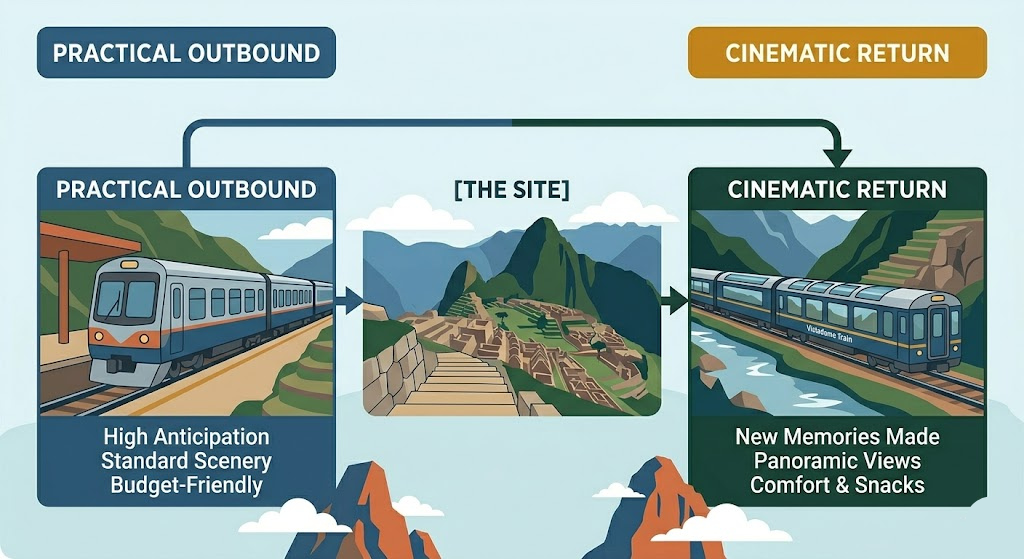
The Unbundled Train Combo
Book a standard service (like PeruRail’s Expedition or Inca Rail’s Voyager) on the way to Aguas Calientes. Your excitement is high, the standard windows show the exact same mountain scenery, and you save money.
On the return leg, upgrade to the Vistadome. When you are physically exhausted after hours of exploring, the panoramic roof windows, calmer carriage atmosphere, and golden hour lighting across the Sacred Valley make the journey home feel truly cinematic.
The Luxury Reality Check
The ultra-luxury Belmond Hiram Bingham train is a stunning, old-world rail experience featuring fine dining, live music, and polished wood interiors. However, understand what you are paying for: theater and hospitality. You are not paying for better scenery, as it travels the exact same tracks. It is a brilliant emotional splurge for an anniversary or a once-in-a-lifetime trip, but it is not a requirement for seeing the valley beautifully.
The Underrated Alternative: The 1-Day Inca Trail
If you want the emotional payoff of walking into Machu Picchu through the iconic Sun Gate (Intipunku) but don’t want to deal with multi-day camping or heavy gear prep, the 1-day Inca Trail (KM 104) is highly underrated.
Arriving by train and bus can feel abrupt—shifting suddenly from a train station to a bus queue to a crowded checkpoint. Entering on foot out of the cloud forest gives the site a gradual, sacred reveal that you feel you have truly earned.
Re-Evaluating Local Culture and "Pueblo" Spaces

To write or travel meaningfully, we have to drop the romanticized myth that local culture in the Sacred Valley is a static, “untouched” backdrop frozen in the 1500s.
In 2026, you will meet Quechua-speaking weavers utilizing smartphones, and teenagers listening to reggaeton while expertly managing traditional textile arts. The culture is living, adaptive, and contemporary.
Weaving Cooperatives: Observational vs. Relational
If you have limited time, choose a thoughtful visit to a community-run weaving cooperative (such as those in Chinchero). Instead of viewing textiles as mere souvenirs, you quickly learn that the natural dyes come from local plants and insects, and the intricate patterns represent complex geometry, generational memory, and cultural survival. It shifts your travel experience from purely observational (looking at things) to relational (connecting with people).
Rehabilitating Aguas Calientes (Machu Picchu Pueblo)
Travel forums often dismiss the gateway town of Aguas Calientes as an overpriced, noisy tourist trap. It will disappoint you if you expect a sleepy mountain village, but if you look at it as a surreal threshold space, it becomes fascinating. It is a roadless town wedged tightly between vertical jungle cliffs and rushing rivers, where travelers from every corner of the planet collide.
The smartest strategy is to stay two nights in town instead of rushing out on a day trip. Walk the roadless stone streets at dawn before the mass shuttle buses start operating. When the shop shutters are still closed and the mist is drifting off the river, the town loses its commercial performance layer and reveals its raw, dramatic cloud-forest character.
Packing for Mobility, Not Fantasy

Many travelers pack for the fantasy of a remote, week-long wilderness expedition rather than the reality of a managed archaeological site with marked paths. Heavy, bulky hiking boots, giant expedition backpacks, and excessive camera gear will only weigh you down at altitude.
Unless you are undertaking a multi-day trek like Salkantay, a lightweight approach is far superior.
The Packing Matrix
| Pack These (The Real Essentials) | Leave These (The Dead Weight) |
|---|---|
| A second pair of dry socks (Changing your socks before the return train completely resets your physical comfort after a sudden rainstorm). | Heavy, rigid hiking boots (High-quality trail runners or broken-in walking shoes handle the stone stairs beautifully and save your knees). |
| Hydrating lip balm (The combination of intense high-altitude sun, dry mountain wind, and dehydration will crack your lips by day two). | Oversized backpacks (Bags larger than 40 x 35 x 20 cm are strictly prohibited at the gate and must be left in luggage storage). |
| Lotion-based sunscreen & repellent (Aerosol sprays are banned at the turnstiles for environmental preservation). | Umbrellas, selfie sticks, and tripods (All are explicitly banned to prevent path blockages and accidental damage to the ruins). |
The One Golden Rule for 2026
If you take only one philosophy away from this guide, let it be this: Stop trying to conquer the trip. Let the trip change your pace instead.
Modern travel culture encourages us to optimize every single minute—seeking the perfect photo angle, the fastest route, and the maximum checklist efficiency. But the Andes do not reward urgency. Altitude demands that you slow down. The shifting mountain weather forces flexibility.
The travelers who leave Peru feeling the most fulfilled are rarely the ones who tried to consume it the fastest. They are the ones who allowed themselves to be absorbed by it—the ones who sat quietly on a terrace edge, put the camera away for the first twenty minutes, and focused on being present in a truly sacred landscape.


